

Every clinical study starts with a study population. But identifying the patients who actually meet that definition requires researchers to translate each inclusion and exclusion criterion into the right variables, filters, and dataset-specific logic. They must also account for missing data, differences in how clinical concepts are recorded, and whether the resulting cohort truly reflects the study protocol.
The challenge is not just the time involved. Population estimates made before the full eligibility criteria are applied can be inaccurate, leaving teams to discover feasibility problems only after significant time and resources have already been committed.
The Briya AIRE Population Agent is designed to make population feasibility faster and more accurate. Researchers describe the population in natural language, and AIRE turns it into structured eligibility criteria while showing in real time how each decision changes the reachable population. This lets teams know before they lock a study design, testing assumptions against real data before they become expensive protocol changes.
That matters because 76% of clinical trial protocols require an amendment, most often to eligibility criteria, while substantial amendments can cost $141,000 to $535,000 each and add months of delay.
How does natural-language population building work?
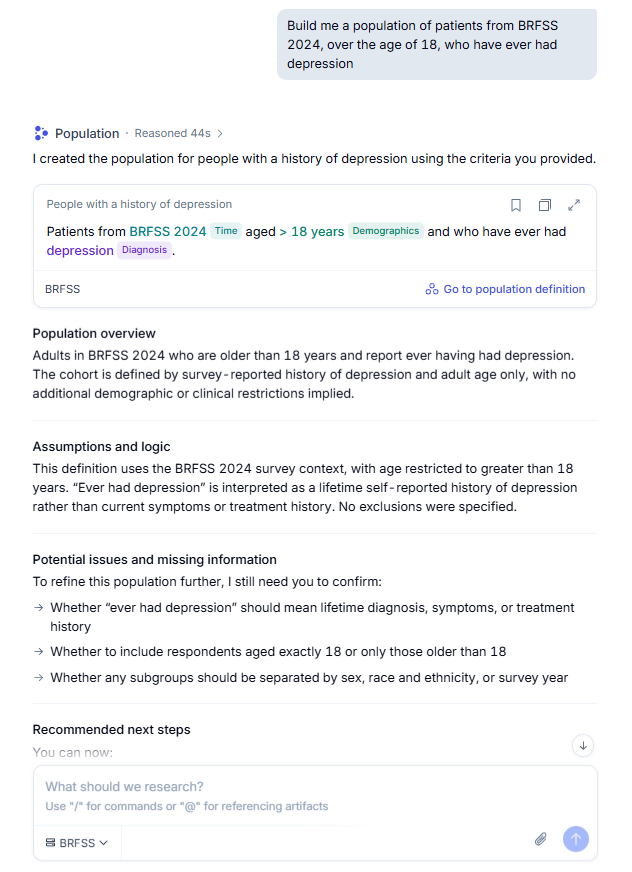
With the Population Agent, researchers describe the population they want in natural language. AIRE’s epidemiologically aware AI interprets the request, defines the relevant inclusion and exclusion criteria, and generates a structured population definition for the researcher to review.
The underlying population logic remains visible, so researchers can refine the criteria, make changes where needed, and approve the definition before it is applied to the data.
For example, a researcher working with BRFSS could ask AIRE to build a population of adults over 18 who have ever had depression. AIRE structures that request into reviewable eligibility criteria and identifies the resulting population.
What does the population funnel show?
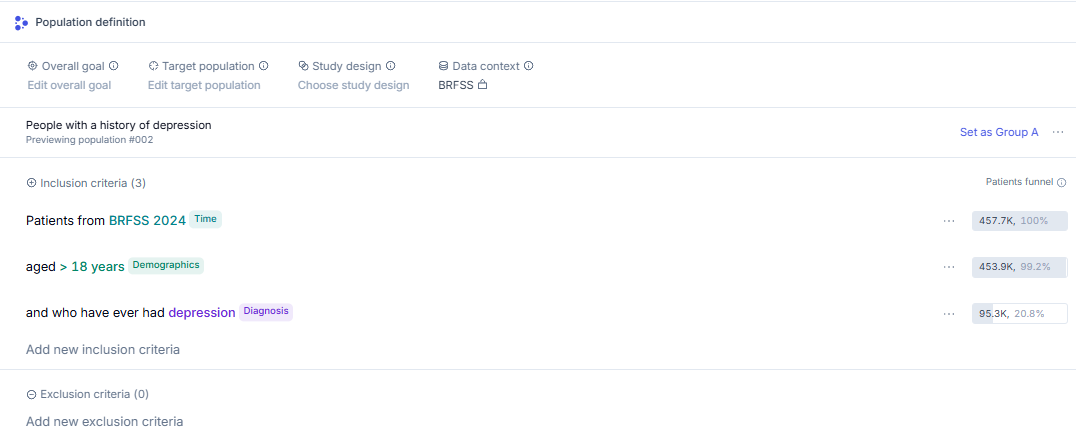
The population funnel shows how the population changes as each inclusion or exclusion criterion is applied.
Researchers can see how individual criteria affect the resulting cohort and validate that the population behaves as expected. If one criterion causes a significant change in the population, that impact is immediately visible rather than buried inside a query or script.
How can researchers refine and inspect a cohort?
Once a population is defined, researchers can review how the approved eligibility criteria were applied, modify criteria, rerun the cohort, and create comparison populations where appropriate.
AIRE can also help researchers refine the population by flagging ambiguities and suggesting additional criteria or clinical signals to consider. The researcher stays in control of the final definition, but does not need to anticipate every rule upfront.
AIRE also provides a table view of the resulting population, allowing researchers to inspect the cohort produced by their criteria before continuing into analysis.
Because the population definition remains structured and reviewable, researchers can return to it, make changes, and rerun the population without rebuilding the cohort from scratch.
Can researchers define timing between population criteria?
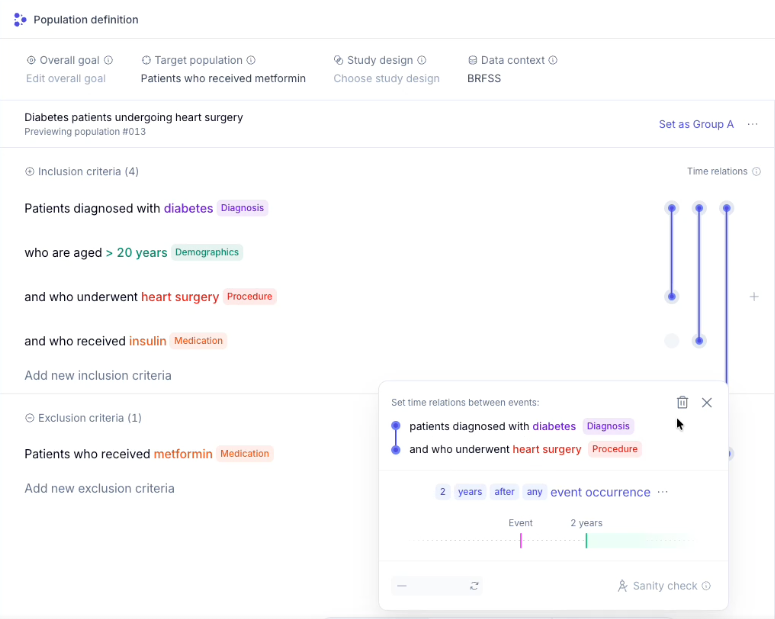
Some study populations depend not only on whether two events occurred, but when they occurred in relation to each other.
With Time Relations, researchers can define that timing in natural language as part of the population criteria. For example, a researcher could adjust a population to include patients who underwent heart surgery one year after a diabetes diagnosis.
The timing rule becomes part of the population itself, so it can be reviewed, edited, and reflected directly in the population funnel and resulting counts.
Researchers can also define an index event in natural language, allowing multiple timing rules to be anchored around the same clinical event.
When should researchers use the Population Agent?
The Population Agent supports different stages of research depending on the data context defined for the study.
With public datasets, researchers can begin exploring populations early in the research process. Datasets such as BRFSS, NHIS, and NHDS are available directly in the browser version of AIRE, can be used to test research questions, refine eligibility criteria, and understand the available population before moving further into a study.
The Population Agent can also be used with an organization’s own institutional or proprietary data, helping teams turn a study population definition into structured criteria they can apply directly to their data.
In both cases, the resulting population remains connected to the broader AIRE workflow for methodology, statistical analysis, and evidence generation.
How can the Population Agent support study feasibility?
The Population Agent can help teams assess feasibility earlier in the study process by testing different eligibility criteria and seeing how those decisions affect the available population.
For CROs, consultancies, life science research and analytics firms, that can start as early as proposal development, helping teams test a proposed cohort before responding to an RFP or committing significant resources to a study.
This gives teams a clearer view of population feasibility earlier in the process, while keeping the underlying criteria and assumptions visible for review.
More room for science
With the population agent, AIRE gives researchers more capacity to focus on the science itself: refining research questions, evaluating methodology, interpreting results, and generating evidence.
The result is more room for science: more research capacity, faster study delivery, and more time for researchers to focus on the scientific questions that matter.
Frequently Asked Questions
What is the Briya AIRE Population Agent?
The Population Agent is an AI agent within Briya AIRE that helps researchers build study populations using natural language. It translates research intent into structured inclusion and exclusion criteria that researchers can review and refine.
When can researchers use the Population Agent?
Researchers can use the Population Agent when they have access to the data required for their research. With institutional clinical data, this depends on the organization’s applicable approvals and access requirements. With public datasets available in AIRE, researchers can begin exploring populations earlier in the research process.
What is the population funnel in AIRE?
The population funnel shows how the eligible population changes as each inclusion or exclusion criterion is applied, making the impact of each criterion visible.
Can the Population Agent help with feasibility?
Yes. When researchers are working with public or otherwise appropriately accessible data, the population funnel can help assess feasibility by showing how many participants meet different population criteria.
Can I create a comparison group?
Yes. The Population Agent supports creating comparison populations within the same population-building workflow.
Is the Population Agent available in the browser version of AIRE?
Yes. The Population Agent is available in the browser version of Briya AIRE, where researchers can work with available datasets such as BRFSS and NHDS.
Related articles

Building Better Patient Cohorts Beyond Claims Data
Claims data is widely used by life sciences companies, ...
Read more
King’s College Hospital NHS Foundation Trust Joins Briya’s Global Data Network
Briya is building a global research network designed to...
Read more
How to Analyze BRFSS Data Faster with Briya AIRE
An Interview with Prof. Jordan Weiss, NYU Grossman Scho...
Read more