

Claims data is widely used by life sciences companies, CROs, consultancies, and research teams to study healthcare utilization, treatment patterns, and patient populations at scale. It provides valuable information about diagnoses, procedures, prescriptions, and patterns of care.
But claims data captures only part of the patient picture.
Important details about a patient’s condition, disease progression, treatment decisions, and outcomes may be found in physicians’ notes, radiology and pathology reports, laboratory results, and other unstructured sources. Without that additional context, identifying complete patient populations and understanding the clinical events behind observed patterns can be challenging.
In a recent webinar, I sat down with Yair Markovits, who has spent more than 15 years working with life sciences companies on data strategy and real-world evidence. We discussed the limitations of claims data, the practical challenges of working with real-world data, and how AI can support patient cohort identification and evidence generation.
Yair participated in a personal capacity; the views expressed are his own and do not represent any current or former employer.
Key takeaways
- Claims data can reveal what happened during a patient’s healthcare journey, but often provides limited insight into the clinical context behind those events.
- Unstructured electronic health record (EHR) data, including clinical notes and imaging reports, can reveal patients and clinical details that structured diagnosis codes alone may miss.
- Integrating claims, EHR, laboratory, genomic, and other real-world data sources requires substantial work to address differences in structure, terminology, and completeness.
- AI can help researchers identify patients, refine cohort definitions, and calculate clinical scores, but the underlying methods and assumptions still require human review.
- Transparency and reproducibility are essential when AI-assisted analyses are used to generate evidence for scientific or client-facing decisions.
Where does claims data fall short for patient cohort research?
Yair Markovits: Claims data tells us a lot about what happened. We can see diagnoses, prescriptions, which physicians a patient saw, and parts of that patient’s healthcare journey. What it often does not provide is the clinical context behind those events.
Why did a patient see a gastroenterologist before their primary care physician? Why was one lab test ordered instead of another? What factors may have contributed to a patient not adhering to treatment?
The answers may be documented in clinical notes, laboratory results, genomic data, or other sources. Bringing those sources together can provide a more complete picture of both what happened and the possible reasons behind it.
What makes real-world data analysis so time-consuming?
Yair Markovits: The data is there. Making sense of it is the challenging part.
You may be working across claims, EHR, laboratory, genomic, and other data sources, each with different levels of completeness and different structures. Before you can answer the research question, you need to understand how those sources relate to one another and whether they can be meaningfully combined.
That harmonization takes time, and the time translates directly into cost. For service firms in particular, a significant part of the work lies between receiving the data and producing an interpretable result.
Reducing that operational burden is important, but it has to be done without compromising data quality or the validity of the analysis.
How can unstructured EHR data help you build a better patient cohort?
Yair Markovits: One example we discussed during the webinar involved identifying patients with steatotic liver disease. It illustrated how much you can miss if you rely exclusively on structured diagnosis codes.
The demonstration used natural language processing (NLP) to identify references to steatotic liver disease in ultrasound reports and compared the resulting population with patients identified through structured diagnosis codes. In that example, the unstructured data identified approximately three times as many patients as the structured diagnosis codes alone.
The broader lesson is that relevant clinical information is not always captured in the fields researchers typically use to define a cohort. A diagnosis may be documented in a radiology report or clinical note without appearing as a corresponding structured code.
Of course, identifying additional patients is only the first step. Researchers still need to assess whether the extracted information supports the intended case definition, validate the results, and account for potential sources of error.
How important is harmonization before you start analyzing real-world data?
Yair Markovits: Real-world data can contain missing values, inconsistent terminology, outliers, and information represented differently across sources. Harmonization is what makes those sources usable together.
But harmonization is not simply a matter of cleaning the data automatically. Researchers need to understand what has changed, why a value has been flagged, and what assumptions are being made.
For example, a missing value may have a different implication from an implausible value or a measurement recorded using a different convention. Those issues should not necessarily be handled in the same way.
Automation can help surface inconsistencies and reduce repetitive work. The important thing is that researchers can review the issues, understand the decisions, and determine how they should be handled in the context of the study.
How can researchers calculate clinical scores from real-world data?
Yair Markovits: Clinical scores are a good example of how data preparation and analysis intersect.
Take FIB-4, a score commonly used to assess the risk of advanced liver fibrosis. Its calculation uses age, AST, ALT, and platelet count. To calculate it reliably across a patient population, researchers need to identify the relevant variables, account for missing or unsuitable measurements, and apply the formula consistently.
That can be useful when the score has not already been documented in the patient record. Rather than relying only on existing values, researchers can calculate it from the underlying clinical data, provided the necessary inputs are available and appropriate.
The same principle applies to other established clinical scores or study-specific algorithms. Researchers may need to define their own formulas, thresholds, and scoring logic, depending on the research question.
The calculation itself is only one part of the process. The choice of measurements, timing of those measurements, handling of missing data, and interpretation of the resulting score all matter.
Can AI help researchers build and refine patient cohorts, or do they need to start with rigid criteria?
Yair Markovits: Researchers do not necessarily need to have every detail rigidly defined before they begin.
Often, they start with a hypothesis about how a population should be segmented. The challenge is making sure the definition is not too narrow, does not introduce unnecessary bias, and does not overlook another meaningful way of looking at the population.
AI can help translate a research question expressed in natural language into draft inclusion and exclusion criteria. It can also help identify ambiguities, highlight assumptions, and suggest alternative ways to define a cohort.
But there is an important distinction between helping formulate a research definition and deciding whether that definition is scientifically appropriate.
Researchers still need to assess whether the proposed criteria match the study objectives, whether they introduce selection bias, and whether the resulting population is suitable for the intended analysis. AI can support that process, but methodological decisions remain the responsibility of the researcher.
How important is transparency when consultants use AI for research?
Yair Markovits: Transparency is extremely important, particularly when you are doing work for a client and need to explain how you reached a result.
An AI-generated answer is not enough on its own. Researchers and consultants need to understand the methodology behind the output, including the data used, the transformations applied, the assumptions made, and the logic used to arrive at the result.
Where possible, being able to inspect the underlying code and analytical workflow makes it easier to review, reproduce, and explain the work.
For consulting firms in particular, that matters because the analysis has to stand up to scrutiny. You need to be able to go back, understand what was done and why, and communicate the methodology clearly to the client.
This becomes especially important when AI is involved in cohort definition, data transformation, or clinical calculations. Greater automation does not eliminate the need for validation and accountability.
Where can AI make a difference in the day-to-day workflow of a consultancy?
Yair Markovits: Everybody wants faster time to insight, but the challenge is getting there without losing rigor or context.
For a service firm, the opportunity is to reduce the manual work that sits between receiving data and answering a research question. That includes tasks such as locating relevant clinical information, standardizing variables, applying analytical rules, and refining patient cohorts.
These are areas where automation may help, particularly when the same types of tasks recur across projects. But the benefits depend on the quality of the underlying data, the suitability of the methods, and how well the workflow fits the research team’s needs.
The goal should not simply be to produce results faster. It should be to shorten the path from data to insight while preserving the expertise, judgment, and quality controls needed to produce defensible evidence.
From Real-World Data to Defensible Evidence
The challenges discussed in this interview reflect a broader issue in real-world evidence generation: access to data is only the starting point. Turning fragmented claims, EHR, laboratory, genomic, and unstructured clinical data into reliable evidence requires careful integration, appropriate analytical methods, and a clear understanding of the limitations of each source.
AI has the potential to make parts of this process more efficient, from identifying clinical information in unstructured records to supporting cohort definition and automating repetitive analytical tasks. Its value, however, depends on more than speed. Results must be interpretable, assumptions must be visible, and researchers must retain control over methodological decisions.
For life sciences companies, CROs, consultancies, and research teams, the central question is therefore not simply how to analyze more data, but how to turn available data into evidence that can withstand scientific and client scrutiny.
About Briya
Briya is the health AI company behind AIRE, a scientific AI platform built to expand research capacity and deliver better evidence. AIRE handles the operational complexity between fragmented data and defensible evidence, while preserving scientific rigor and keeping researchers in control.
Related articles
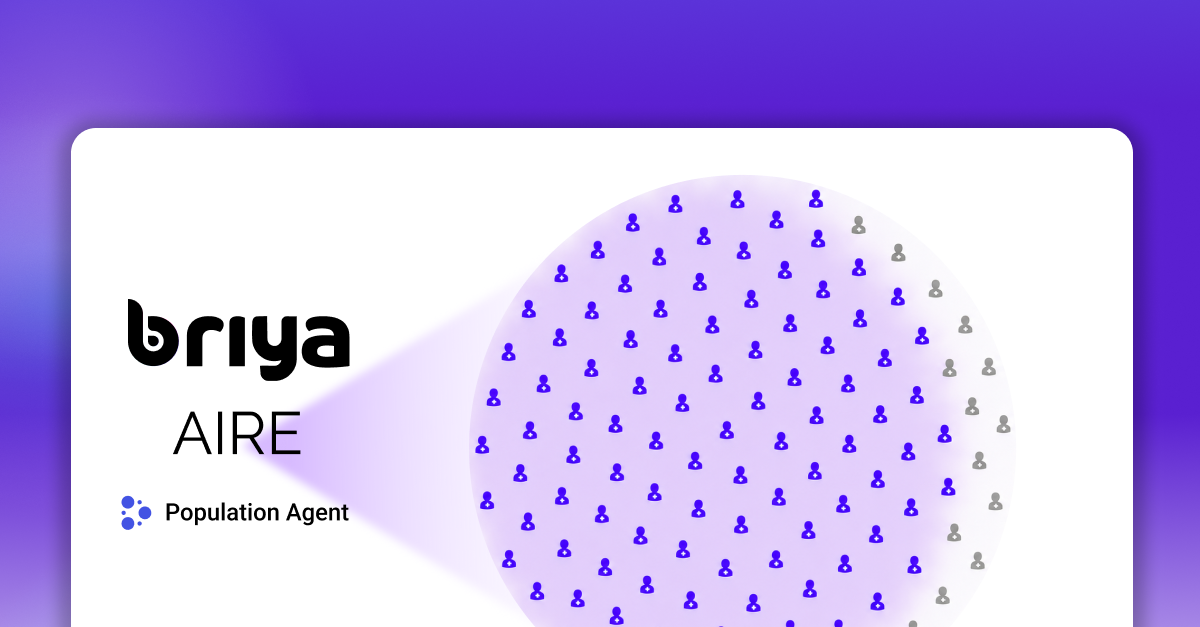
Introducing the Briya AIRE Population Agent
Every clinical study starts with a study population. Bu...
Read more
King’s College Hospital NHS Foundation Trust Joins Briya’s Global Data Network
Briya is building a global research network designed to...
Read more
How to Analyze BRFSS Data Faster with Briya AIRE
An Interview with Prof. Jordan Weiss, NYU Grossman Scho...
Read more